

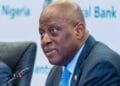
Central Bank of Nigeria (CBN) Governor Olayemi Cardoso says the bank may begin cutting interest rates next year if inflation maintains its current downward trajectory.
Speaking at the annual bankers’ dinner in Lagos on Friday attended by Fintech Inisghts, Cardoso highlighted the steady decline in inflation, which fell to 16.05% in October 2025, down from 33.88% a year earlier. Month-on-month inflation also eased to 1.97%, while food inflation dropped sharply to 13.12% from 39.16% in October 2024.
“Our models project continued disinflation in 2026, helped by stronger domestic production, improved foreign-exchange liquidity, and more disciplined liquidity management,” Cardoso said. “As inflation moderates and becomes firmly anchored, we will calibrate the policy rates in line with evolving data.”
ALSO: World Bank Calls for Overhaul of Nigeria’s Trade Policy to Fight Inflation, Poverty
Focus Areas for 2026
Cardoso outlined the CBN’s priorities for the coming year, including:
-
Strengthening the banking system
-
Protecting depositors through tighter supervision and governance
-
Deepening financial stability
-
Modernising the payments ecosystem
-
Reinforcing Nigeria’s overall economic resilience
The governor stressed that achieving and maintaining “durable price stability” remains central to monetary policy, supported by enhanced analytics to anchor expectations.
Fintech, Payments, and Inclusion
Cardoso reaffirmed the CBN’s commitment to expanding financial inclusion and modernising payment systems.
Key updates include:
-
Extension of the Payment System Vision roadmap to 2028
-
Over 12 million contactless payment cards now in circulation
-
A regulatory sandbox expanded to 40+ fintech innovators
-
Stronger guardrails for digital-asset testing
-
Increased focus on consumer protection, cybersecurity, and data governance
He said fintech innovation will continue to grow, but under stricter licensing and regulatory clarity.
No More CBN Deficit Financing
Cardoso reiterated that the era of using the central bank to finance government deficits “has ended,” emphasizing that monetary and fiscal discipline is now non-negotiable.
The federal government, he noted, is supporting this stance through new institutional reforms such as:
-
The National Revenue Agency
-
A Revenue Optimisation Framework
-
Upgrades to the Treasury Single Account (TSA)
Rising Investor Confidence and Stronger External Position
Cardoso highlighted Nigeria’s sharp rebound in capital inflows, saying foreign investments reached $20.98 billion in the first ten months of 2025 up 70% from all of 2024 and more than four times 2023 levels.
He also noted:
-
Current account surplus rose 85% to $5.28 billion in Q2 2025
-
FX reserves climbed to $46.7 billion by mid-November, the highest in nearly seven years
-
Reserves now provide 10+ months of import cover
“Our FX reserves are being rebuilt organically not through borrowing, but through improved market functioning, stronger non-oil exports, and robust capital inflows,” he said.
Cardoso concluded by reaffirming the CBN’s commitment to stability, discipline, and sustained reforms that support a resilient, investment-ready economy.






Comments 2