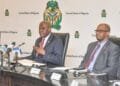

The Central Bank of Nigeria (CBN) is setting a new strategic direction for 2026, with Governor Olayemi Cardoso announcing a series of reforms designed to strengthen the banking system, protect depositors, modernise payments, and support Nigeria’s economic stability.
Speaking at the 2025 Bankers’ Dinner organised by the Chartered Institute of Bankers of Nigeria (CIBN) in Lagos, Cardoso said the CBN’s priorities for 2026 reflect its core mandate: safeguarding financial stability and delivering lasting price stability.
Banking Stability and Depositor Protection
Cardoso said the CBN will intensify supervision, raise governance standards, and push for sustainable credit expansion, stressing that depositor protection remains “non-negotiable.”
ALSO: FG Crackdown on 28 Million Fraudulent Accounts Raises Fresh Questions About Fintech Trust
He revealed that the Bank will continue tightening oversight to ensure resilience across the financial sector.
Focus on Price Stability and Inflation Targeting
The CBN governor emphasised that tackling inflation remains central to monetary policy.
He said the inflation-targeting framework will be upgraded using advanced analytics to anchor expectations and reduce inflation sustainably.
Payments Modernisation and Financial Inclusion
The CBN will accelerate the expansion of digital payments in 2026, strengthening payment rails and increasing the adoption of contactless payments nationwide.
Cardoso noted that Nigeria’s payments transformation has progressed rapidly, with more than 12 million contactless cards already in circulation.
Fintech Regulation and Innovation
Cardoso said fintech innovation will remain a key priority, but with stronger protection frameworks.
The CBN will enforce stricter rules on:
cybersecurity
consumer protection
licensing requirements
data governance
digital-asset experimentation
He highlighted the growth of the CBN’s regulatory sandbox, now hosting over 40 fintech innovators.
Internal Reforms and Regulatory Coordination
The CBN is improving internal processes, upgrading staff capacity, and reducing licensing bottlenecks to enhance regulatory efficiency.
The Bank will also deepen collaboration with local and global regulators to reinforce Nigeria’s credibility.
End of CBN Deficit Financing
Cardoso reiterated that the era of using the CBN to finance government deficits is over.
He said the bank will not return to monetary financing under any circumstances, adding that fiscal authorities are implementing structural reforms such as:
the Revenue Optimisation framework
the National Revenue Agency
upgrades to the Treasury Single Account
These reforms, he said, will strengthen public finance and support the shift to a full inflation-targeting regime.
Strong Recovery in Foreign Inflows and External Reserves
Cardoso said investor confidence rebounded strongly in 2025, with foreign inflows reaching US$20.98 billion in the first 10 months, up 70% from total 2024 inflows and 428% higher than 2023.
Nigeria’s current-account balance also surged to US$5.28 billion in Q2 2025, while external reserves climbed to US$46.7 billion, the highest in nearly seven years.
He emphasised that the reserves are being rebuilt “organically”, not through borrowing, but via stronger exports, improved market functioning, and rising capital inflows.
A Strategic Shift for 2026
Cardoso concluded that the CBN’s 2026 agenda is “practical, measurable, and fully aligned” with its mission to stabilise prices, protect the financial system, and strengthen Nigeria’s economic resilience.